
Every trading session leaves behind a high and a low. Traders often place stop orders just beyond them: stops for shorts above a high, stops for longs below a low. That cluster of resting orders is what people mean by liquidity.
What a sweep is
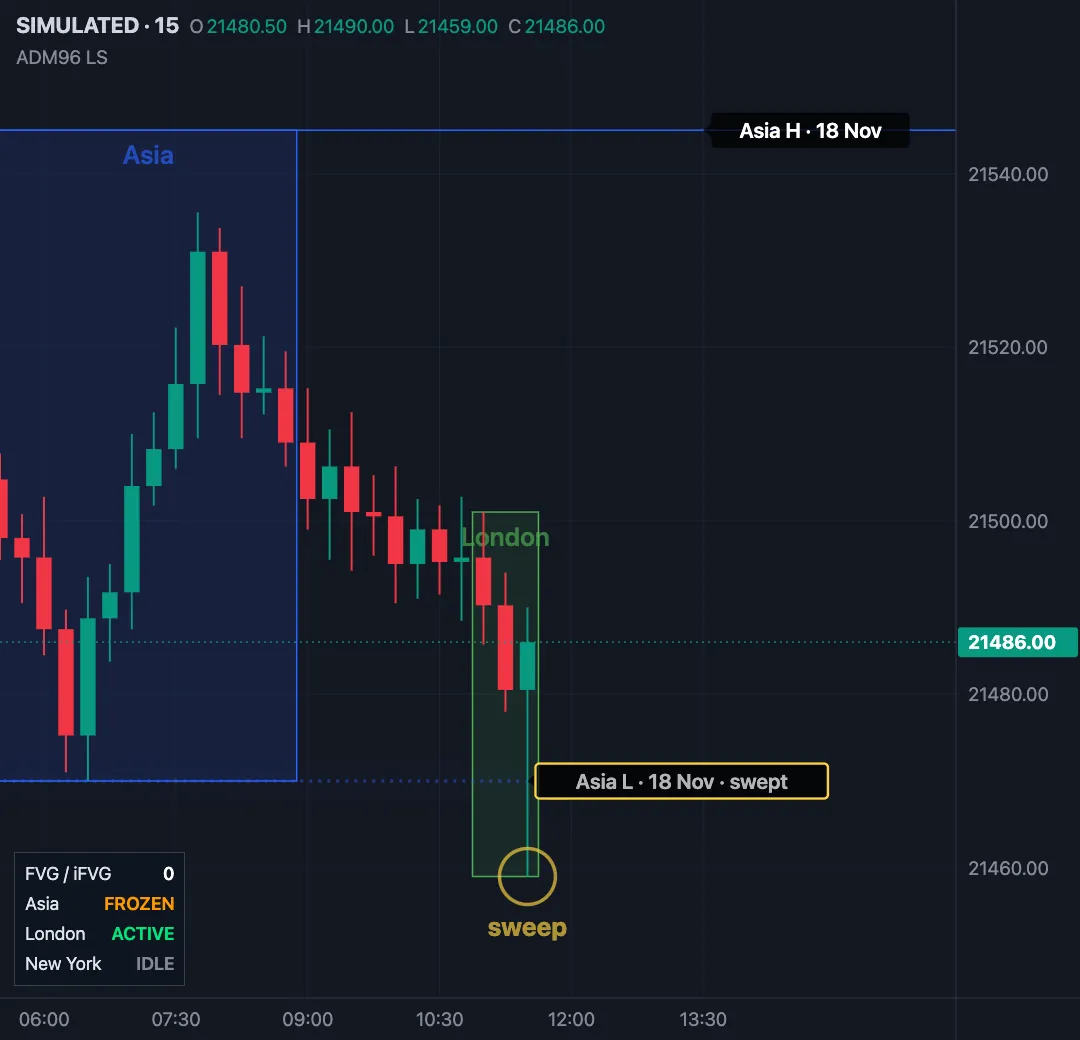
When price trades through one of those highs or lows, the resting orders there get filled. That's a sweep. Sometimes price keeps going; sometimes it reverses quickly once the orders are used up. A sweep tells you that the level was reached, not what happens next.
The hard part: keeping track
On a live chart, it's easy to forget which of the last few days' Asia lows or London highs have already been taken. A level that was swept yesterday probably has less resting liquidity than one that's never been touched.
How Liquidity Suite tracks it
- Asia, London and New York highs and lows, plus PDH/PDL, are kept for up to 15 trading days.
- Each level appears only after its session ends, with its source and date in the label.
- The moment a wick trades strictly beyond a level, the line stops at that candle, fades and says
swept. Sweeps are checked on 1-minute data.
The result is a chart that shows untouched liquidity at a glance, and when each level was taken.